Brazilian Butt Lift: 1-year post cosmetic surgery
Most post surgery Brazilian Butt Lift (BBL) photos you see are taken approximately 6 weeks after the cosmetic surgery is performed. This is a time when most bruising has subsided, swelling reduced and true results become more visible.
We’re fortunate to have the opportunity to share a Cosmos Clinic patient’s BBL journey from the beginning to 1-year post undergoing the Brazilian Butt Lift procedure. In a video posted on our Instagram feed, we share the patient’s before photos and follow up images so you can see long-term final results of the cosmetic surgery.
The patient also shares photos of her BBL surgery results while wearing figure hugging clothing. This may help you visualise what your results may look like after receiving liposuction and fat transfer during your own buttock augmentation procedure.
Immediate transformation
As you can see in the photos taken 3 and 6 weeks after the Brazilian Butt Lift procedure, the patient’s shape has immediately changed. By removing excess fat from the love handles and lower back using liposuction, the cosmetic practitioners have been able to contour her figure, creating the desired ‘V’-shape. The patient’s inner thighs have also been contoured in the process.
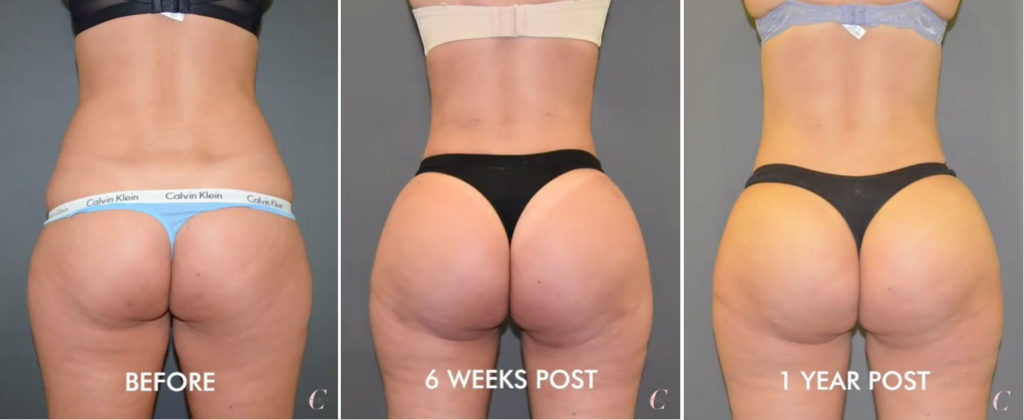
Most of the fat injections were targeted to the upper two-thirds of the buttock so that a smooth ‘S’ shape can be achieved. The liposuction and fat transfer work together to accentuate the shape of the buttock.
See more Brazilian Butt Lift Before and After photos here.
Naturally curvaceous results
Fast forward to 1-year post the Brazilian Butt Lift and you’ll notice the final results are a naturally curvaceous figure. While the lift and full shape have remained, with no swelling, the appearance of the patient’s derriere is much more natural.
A softening of the buttock size and contouring has also occurred due to some fat cells dying after the transfer. Experience tells us about 80% of fat cells injected survive the fat grafting and will remain long-term.
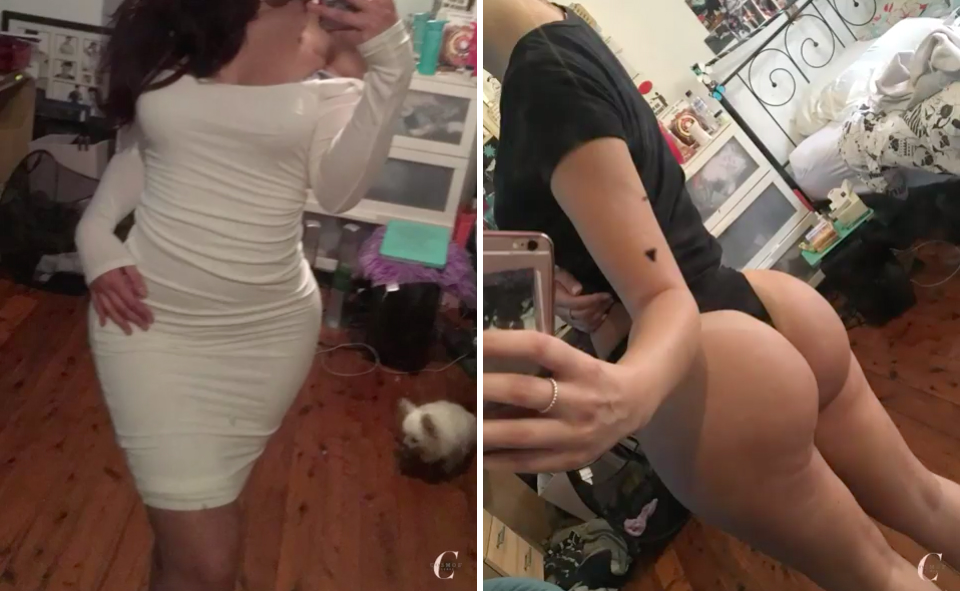
You may also notice the scarring is minimal and doesn’t prevent the patient from showing off her new figure in revealing underwear. If this is a concern for you, read more about scarring after BBL and Vaser liposuction here.
Beyond the final results of an enhanced derriere and naturally curvaceous figure, we’ve noticed how confident this patient is in her own skin after the Brazilian Butt Lift procedure.
Discover more about the BBL procedure here or find out if you are a good candidate for cosmetic surgery by contacting the Cosmos Clinic team here or calling on 1300-138-797.
Will I Get Stretch Marks after a Brazilian Butt Lift?
Over on the Cosmos Clinic Instagram Feed, Dr. Joseph Ajaka answers this week’s direct message: Do Brazilian Butt Lifts cause stretch marks?
Stretch marks after a Brazilian Butt Lift (BBL) procedure is a common concern for many and rightly so. The last thing you want after a butt lift procedure is to be self-conscious due to visible stretch marks.
Incurring stretch marks after BBL cosmetic surgery is rare. Cosmos Clinic has performed over 4,000 BBL’s since 2010 and the majority of patients don’t develop new stretch marks post procedure.
Why do stretch marks occur
Stretch marks are visible scars or lesions on the skin that typically affect the abdomen, buttocks, hips, flanks, thighs and breasts. They form in the middle layer of the skin known as the dermis when the connective tissue expands and stretches beyond its elasticity limits. The dermis, in turn, can tear allowing the deeper layers of the skin to be visible.
Additionally, if your skin lacks collagen stretch marks can form as collagen is the protein that makes the dermis elastic. Low collagen means your skin’s ability to stretch without a consequence is reduced.
There are several common causes of stretch marks:
- Puberty and rapid growth;
- Pregnancy;
- Rapid weight gain;
- Medical conditions such as Cushing’s syndrome;
- Regular anabolic steroid use.
While stretch marks eventually flatten and fade over time, they can greatly impact self-body image and confidence. Whether you’ve had a BBL, breast augmentation or any other body contouring cosmetic procedure, incurring stretch marks isn’t desirable.
Treating stretch marks if they do occur after BBL
In about 2 of the Cosmos Clinic BBL patients, we have noticed new stretch marks have formed after the fat transfer treatment.
These have been successfully treated with Platelet Rich Plasma (PRP) which is a procedure that involves injecting plasma into the dermis through a fine needle. This concentrated plasma is enriched with your own platelets, growth factors and natural stem cells which can help to repair and rejuvenate soft tissue of the treated areas.
In addition to treating stretch marks, PRP therapy can help with the appearance of cellulite, acne scarring, skin tightening, fat transfers and burns.
Preventing stretch marks
The occurrence of stretch marks after a Brazilian Butt Lift or other cosmetic treatments such as liposuction, can’t always be prevented. While it is very rare, the quality of your skin, your skin care routine and dietary habits may influence its appearance and the results of your body contouring procedure.
Making the following lifestyle tips may help you reduce the risks of stretch marks occurring particularly after a cosmetic procedure:
- Maintain a healthy weight and avoiding rapid weight loss;
- Avoid fad diets you see on social media;
- Remain hydrated drinking 2L of water daily;
- Eat plenty of fruit and vegetables rich in vitamins A, C, E, and zinc;
- Consume omega-3 fatty acids found in cold-water fish, nuts and seeds;
- Safely expose yourself to the sun for vitamin D;
- Use a quality moisturiser to keep your skin supple;
- Limit or avoid anabolic and corticosteroid creams.
Keep an eye out on the Cosmos Clinic Instagram Feed where every Friday we’ll answer some of the most intriguing and popular questions regarding cosmetic surgery procedures.
If you’re interested in finding out more about one of the treatments offered at Cosmos Clinic, you can contact us here or call our team at 1300-138-797.
BBL Recovery: Answers to Your Top Questions
The Brazilian Butt Lift procedure (BBL) is one of our most popular treatments at Cosmos Clinic. But one of the things we get asked about the most about beyond the final results is recovery.
In this video, Dr Joseph Ajaka gives you the rundown on the BBL recovery after your cosmetic surgery and answers the most common questions we get asked.
1. Do I need to wear a compression garment?
Yes, after your Brazilian Butt Lift surgery you will be put into a compression garment. This garment is tightly fitted and features open panels in the buttock area to avoid putting pressure on the fat cells the cosmetic practitioner has injected.
To ensure optimal final results and speed up the recovery time, we advise you to wear the compression garment full time for 3 weeks. This should be followed by wearing the garment 3 weeks on a part-time basis.
When removing the compression garment to shower, Dr Ajaka recommends you lie down for 10-15 minutes to avoid fainting. He also suggests you make sure the water isn’t too warm so as not to affect the fat transfer.
2. How do I sit after having BBL surgery?
After your BBL surgery, we recommend you position a cushion under your thighs and allow your buttocks to overhang for the first two weeks post-op. This can help to avoid pressure on your buttocks during the recovery process. While there are BBL pillows on the market, a small cushion that provides you with enough support should suffice.
After this period, we recommended restricted sitting where you’re sitting forward, putting the weight on your thighs rather than your buttocks. Sitting in this position can be continued during the recovery period for up to six weeks.
3. What position should I sleep in after having a Brazilian Butt Lift?
Please, don’t sleep on your side after your BBL surgery. This puts pressure on the fat cells we injected into the side and the blood circulation to these areas of the body is relatively poor. This can affect the end results of your buttock augmentation.
The most comfortable and ideal position to sleep after your BBL surgery is on a 45-degree angle as seen in the video. In this position, the weight is on your thighs and the sides and buttock areas which received the fat transfer are free of any pressure.
If preferred, you could also sleep on your stomach with your arms by your side. You may, however, notice some swelling of the hands, feet and face especially after your first evening post-op.
While it’s not the most ideal position, you can sleep on your back. We recommend you avoid this until 2-3 weeks after your BBL surgery so it does not affect your final results.
4. Do I need to have the lymphatic drainage massages?
The lymphatic drainage massages are a very important step in your BBL recovery. They can help the healing process and improve your final results.
The lymphatic drainage massages help to move the fluid out of the area and reduce the swelling. This can also help to improve any discomfort experienced during your Brazilian Butt Lift recovery. We strongly advise you to attend all your lymphatic drainage massage appointments to support the recovery process and improve the long-lasting results of your BBL surgery.
All the post-surgery care information will be discussed with you and given to you in your care package along with information about medications and any possible complications.
To find out more about the Brazilian Butt Lift procedure and the body contouring results, click here.
You can contact us here for consultations or call us at 1300-138-797 to get in touch with our team of experts for further information.
Male vs Female Brazilian Butt Lift
Did you catch Dr. Joseph Ajaka explaining the difference between a male BBL and a female BBL on our Instagram Stories earlier this week?
In case you missed it, here is a summary of the Brazilian Butt Lift procedure and how it differs between males and females.

What is a Brazilian Butt Lift?
A Brazilian Butt Lift (BBL) is a surgical procedure that can assist in reshaping the buttocks to give volume and create the desired shape. Using your own purified fat transferred from your abdomen, thighs or back allows for a precise and more natural look, as well as reduces your risk of infection.
The procedure is performed under general anaesthetic or conscious sedation, while the fat is extracted via liposuction and injected into the targeted areas of the buttocks. Results of a BBL can be noticeable immediately, however, true results are seen after 6 weeks once all the swelling has subsided.
Male vs Female Brazilian Butt Lift
The procedure of a BBL is relatively similar for both males and females, however, there are key differences.
Firstly, during a male BBL, we avoid injecting fat into the sides of the hips as men naturally have a straight up and down physique. Likewise, we don’t inject into the ‘love handle’ region due to the male natural hip structure. In fact, depending on the weight distribution, fat may be removed from the ‘love handles’ and lower back to give an overall chiselled look.

In a female BBL procedure, we inject the purified fat into the upper two-thirds of the buttocks to give a lift and volume. This results in a smooth ‘S’ shape that allows for natural body contouring.

In a male BBL procedure, we inject the entire buttocks with the purified fat accentuating the ‘C’ shape. This is because a male buttock is naturally flat and has the same level of volume distributed throughout the three quadrants. Evenly distributing the fat offers a more pronounced and shapelier look that’s still in keeping with a male’s natural physique.
You can learn more about female BBL procedure here. Information regarding male BBL procedure can be found here.
Further information
Check out our blog for more guides and articles like this or have a look at Cosmos Clinic’s info page to learn more about cosmetic surgery procedures.
You can contact us through this page for consultations or call us at 1300-138-797 to get in touch with our team of experts for further information.
BBL Expert and ‘Buttman’ Dr Aslani Visits Cosmos Clinic
The team at Cosmos Clinic got their New Year off to a great start when famed surgeon Dr Alexander Aslani, from Spain, spent a few days sharing his latest tips on Brazilian Butt Lifts.
(more…)Dr Ajaka Discusses New Hospitals for Cosmetic Procedures
[00:00:00] Dr. Joseph Ajaka: We’ve recently opened a new hospital only about two weeks ago. It’s been quite the journey to get there. It’s quite difficult to find premises that fits all the criteria needed. You need to have two exits, you need to have an ambulance bay, the building needs to comply in many ways with the local health departments. Once you found that facility, the next step is to get an architect who can draw it up to New South Wales health standards or the local health standard that are required in the different states. The building process can take about nine months and then you’re on your way once you receive the approval from the local health department they walk through.
[00:00:42] Interviewer: What has the standard been before that? What have people been able to get away with in terms of where they’ve been carrying out cosmetic operations because they fall under different guidelines to normal hospital approach, don’t they?
[00:00:52] Dr. Joseph Ajaka: Correct. In the middle of 2016, the New South Wales government introduced new legislation which said that any major cosmetic procedure needs to be performed in a licensed facility, which means it needs to be formed in a hospital facility. Licensing means that any complications need to be reported to the local health department. The facility needs to be credited, which means certain protocols and procedures need to be put in place and need to be followed. You get audited every one to three years. It’s a higher level of care for all patients across the country. We welcome the changes.
[00:01:30] Interviewer: Now, obviously you’re trying as a doctor, but along the way, you’ve had become a businessman and a property developer as well, haven’t you? Tell me about your journey, if you like, through where you started and where you are now.
[00:01:39] Dr. Joseph Ajaka: I remember signing a lease 11 years ago and being so nervous about signing a lease. We started off in Double Bay. Three or four years later, we bought a property in Double Bay and fitted out the whole clinic. We’ve since build a hospital recently. We’ve also opened clinics in Canberra about eight years ago, in the Gold Coast about four years ago, and in Adelaide about six years ago.
Along, I’ve had lots of guidance from my brother who’s an actuary, and he’s in private equity and property development and pubs, a lot of guidance. It’s been a great journey, and I’ve learnt a lot. I wish in medical school they teach you a bit of business alongside of all the medical stuff because it would be very useful.
[00:02:24] Interviewer: Has that been as much a part of growing the business like the property side as much as the cosmetic in staying ahead of the trends and what the latest piece of equipment is? It’s also very much on where you position your clinic and how you grow with legislation.
[00:02:36] Dr. Joseph Ajaka: Absolutely. If you look at, say, for example, Laser Clinics, they grew by positioning themselves in very good positions, and you can see Laser Clinics in every major corner now. Yes, they’re a massive company across the country.
[00:02:49] Interviewer: Should people be wary of cosmetic procedures that take place out of these really regulated facilities? Obviously, we know that they do happen.
[00:02:57] Dr. Joseph Ajaka: Yes, they still do happen. People find ways of getting around the legislation. There’s not many people policing them, which is the worrying thing. I think Victoria has come up with even tighter regulations only in July which makes it pretty much impossible to get around the regulations, and I do see that happening across the country in the next couple of years as well.
[00:03:19] Interviewer: Why did you get in to this as a business as opposed to just taking it as a standard medical track?
[00:03:24] Dr. Joseph Ajaka: It wasn’t a planned decision. It was something that I genuinely love doing. I had cosmetic procedures myself about 15 years ago, and I saw the impact that had of myself and then I started treating patients, and I saw that positive impact that it had on them as well. That’s why I started the business, so it’s all been a bonus and a learning experience on top of that. I went with my passion and that’s why we’ve ended up where we are.
[00:03:51] Interviewer: There’s people who are sometimes uncomfortable about seeing the idea of medicine as a business, but it is at any level, isn’t it?
[00:03:56] Dr. Joseph Ajaka: Absolutely. We have 50 employees across the country, and we have four officers. There’s always something to juggle regarding the business side of things. It’s not just all medical. I try and delegate a lot of that to other people so I can focus on the medical stuff, but you still have to have some degree of involvement and you do learn a lot along the way.
[00:04:21] Interviewer: That is the main way to advance through your career in any medical discipline, isn’t it? by sort of taking ownership of a business and growing that in itself.
[00:04:29] Dr. Joseph Ajaka: Absolutely. The other important thing is have a great team behind us. I mentioned my brother helped with the hospital, but we have a great head nurse, Tommy, and he’s been liaising with the New South Wales health department heads. It’s not an easy process, and there’s many hurdles to overcome, so you need a great team to build a hospital really and to staff it as well.
[00:04:50] Interviewer: Are there other sort of areas of medicine where this is happening where people are developing a whole hospital and it’s not like your local public hospital?
[00:04:58] Dr. Joseph Ajaka: Yes, I think in ophthalmology, that’s another big area, and gastroenterology, they’re the two big areas, so colonoscopies have specialised little hospitals now that just do scopes and same with eye surgeons, they have their own little hospitals. They’re the main three ones that they’re coming through.
[00:05:17] Interviewer: Do they tend to also be privately owned and have those same requirements for an ambulance bay and all sorts of things?
[00:05:21] Dr. Joseph Ajaka: Absolutely, yes. They’re usually owned by an ophthalmologist or gastroenterologist, the other local hospital that’s been built next to us in Double Bay is owned by a gastroenterologist and the other one in town, in the city, is owned by ophthalmologists so, yes. There’s lots of doctors who are now taking it upon themselves to build hospitals just for their own benefit. It’s a convenience thing as well. When a patient wants to book a procedure, you have to call the hospital to book it. If that time slot is not there, then it becomes very difficult for the patient and for you, while if you have your own facility, it’s much more convenient. You can do it whenever you want.
[00:05:58] Interviewer: Do you think there is reassurance for patients now whether it’s ophthalmology, or gastroenterology, or cosmetic procedures to know that the hospital that they’ll be at meets the same requirements as any hospital?
[00:06:08] Dr. Joseph Ajaka: Absolutely. Pretty raising the bar is great for everybody, may increase the running cost but overall it improves the experience and you have to do the care for the patient and that will in the long term help everybody.
[00:06:23] Interviewer: As for cosmetic medicine, do you see that is something that’s going to continue to grow. Obviously, there’s new procedures coming online and there’s a shortage of patients wanting to change things about themselves?
[00:06:33] Dr. Joseph Ajaka: I’m still amazed by the last couple of years in the growth in the industry. I started in the industry 15 years ago. I knew it was going to be a big industry, but I’m still blown away by how big it is and how mainstream it has become. The growth in the last four years in our business has been much greater than say in the first seven years of the business, and I honestly think it’s because of the rise of social media.
We’re all having wrist injuries because of Instagram, and we all want to look a certain way, and the technology is becoming more advanced and safer, so the industry here just keeps skyrocketing. There’s new technologies all the time that we have to keep abreast of, and that’s really exciting for me to be part of such a dynamic industry. I’m glad that I took this course in my career.
[00:07:21] [END OF AUDIO]
Feminine Curves Are Here To Stay Says Dr Ajaka
With curvaceous celebrities such a Beyoncé, Jennifer Lopez and Kim Kardashian in the spotlight and an increase in inspirational fitness enthusiasts trending on Instagram, cosmetic surgery to enhance curves is more popular than ever.
Dr Ajaka told Daily Mail Australia, feminine “curves are definitely in and here to stay”.
Tradies Opt for Cosmetic Surgery To Restore Body Confidence
Cosmetic surgery has previously been considered a woman’s domain, largely influenced by celebrities and models. However, a growing number of men are opting to enhance their looks with cosmetic treatments, including a surprising group: tradies.
Breast Implant Cancer Risk Could Drive Fat Grafting
In 2016, the World Health Organisation recognised breast implants were associated with a rare blood cancer known as anaplastic large cell lymphoma (ALCL). It’s believed this form of cancer is caused by low amounts of bacteria being introduced during the breast augmentation surgery. This may cause low grade inflammation that can lead to the growth of this type of lymphoma.
Study Says Your Face Reveals If You’re Rich Or Poor
Your facial expressions could allow people to determine how healthy your bank balance is upon the first meeting.
A recent study by social psychologists of the University of Toronto has revealed people can tell whether you’re rich or poor based on your facial cues and regardless of your gender and race. Researchers explain in the Journal of Personality and Social Psychology, those people with a wealthier appearance are more likely to be successful candidates of a job than their poorer counterparts.